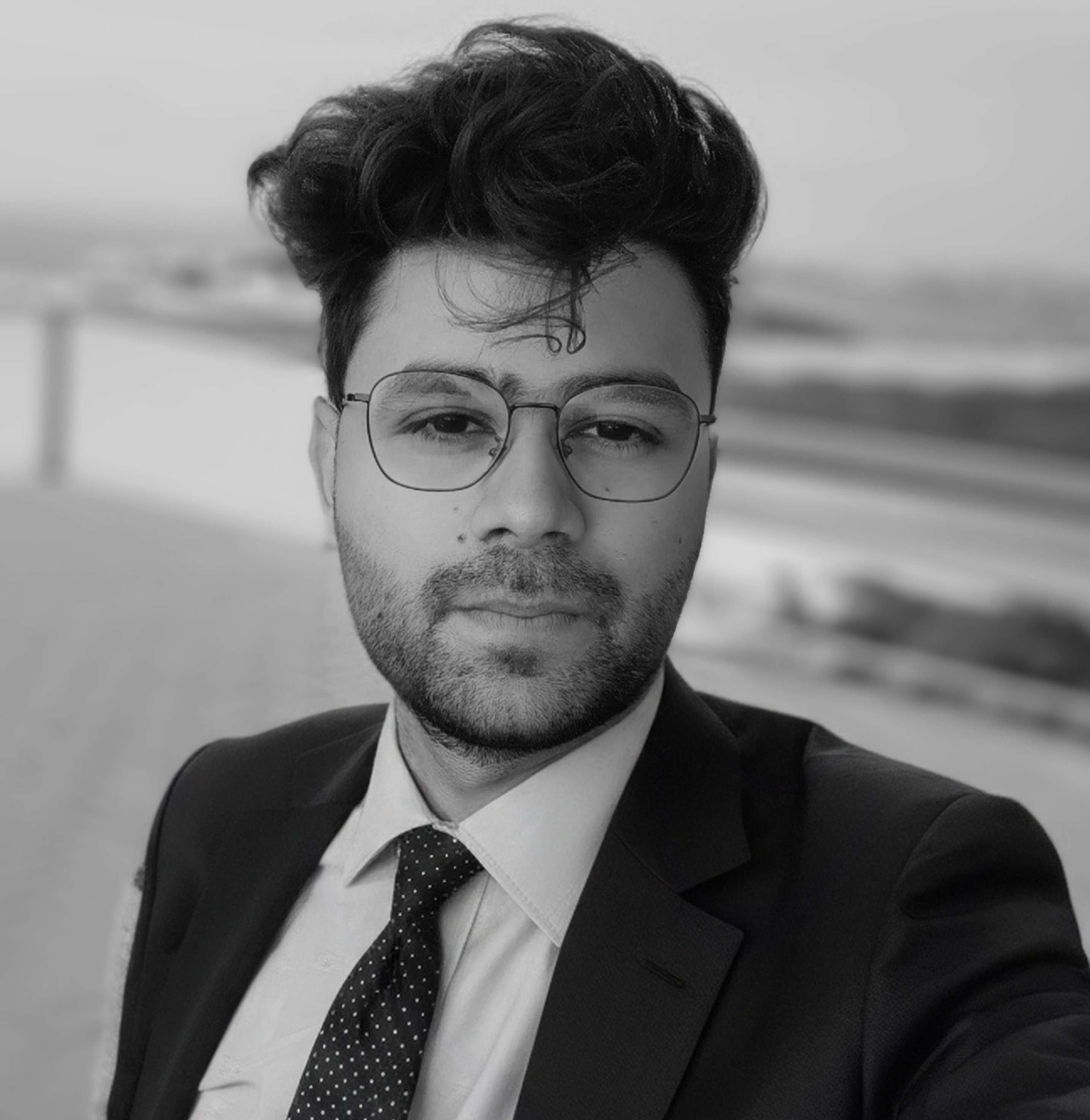
S Anas Ahmad

Researcher in English & Digital Humanities

I work at the intersection of postcolonial studies, digital humanities, game studies, and electronic literature, examining how cultural, technological, and scholarly systems that claim universality embed particular epistemological and political conditions that become visible when analysed from Global South subject positions.

I hold a PhD in English from Aligarh Muslim University (2025), and was awarded the Maulana Azad National Fellowship as Senior Research Fellow. I am the Founder of SHABD India and a Core Team Member of E-Lit India.

S Anas Ahmad
I investigate how cultural, technological, and scholarly systems that present themselves as universal produce different effects when encountered from postcolonial subject positions, using frameworks drawn from spatial theory, infrastructure studies, hermeneutic philosophy, and postcolonial criticism.

My current work centres on three connected enquiries. The first concerns how AI reading environments restructure the hermeneutic architecture of interpretation — introducing a computational intermediary into what the Western tradition has theorised as a dyadic encounter between reader and text, and what this means for the politics of knowledge and meaning-making. The second asks how digital simulation infrastructures (such as volunteer-run flight simulation networks) reproduce postcolonial hierarchies through what I term infrastructural inheritances: the persistence of historical standards, route imaginaries, and governance logics within contemporary digital systems. The third examines how globally circulating fields such as Digital Humanities and Electronic Literature land differently in Indian institutional soil — and what distinctively Indian frameworks might look like.

Across these projects, the consistent intellectual operation is to take a system, form, or framework that presents itself as culturally neutral, and demonstrate through close analysis that it is spatially, politically, and culturally situated, with particular attention to how it functions differently in Indian and Global South contexts.

I serve as Corresponding and Lead Guest Editor of a Scopus-indexed special issue in the Journal of Underrepresented and Minority Progress on "Digital Marginalisation, AI Bias, and Cultural Representation in South Asia" (forthcoming January 2027, co-edited with M. Rizwan Khan and Samya Brata Roy).

Algorithmic Hermeneutics
The process by which computational systems structure the interpretive pathways through which readers encounter textual meaning.
Infrastructural Inheritances
The persistence of historical standards, route imaginaries, and governance logics within contemporary digital systems.
Interpretive Infrastructure
AI reading environments functioning as infrastructure whose shaping of interpretation remains largely invisible, operating through a "double concealment."
The Fourth Epoch of Reading
AI-mediated reading as a historically distinct mode, distinguished from digital reading by the computational mediation of interpretation itself.
Techno-Indigeneity
Developing globally relevant yet locally grounded digital methodologies rooted in Indian epistemic traditions and material conditions.
Indian Postcolonial DH (IPDH)
A framework for Digital Humanities practice rooted in Indian postcolonial conditions, resisting the unreflective transplantation of Euro-American DH.
Under Review
2025
Algorithmic Hermeneutics, Synthetic Dialogue, and the Fourth Epoch of Reading Under ReviewScopus Q1
S Anas Ahmad, M. Rizwan Khan, and Filza Zaki Khan. Discover Artificial Intelligence, Springer.
2025
Quantum Colonialism and the Constitution of Quantum Humanities: A Postcolonial Critique Under ReviewScopus Q1
S Anas Ahmad and Shanmugapriya T. Interventions: International Journal of Postcolonial Studies, Taylor & Francis.
Forthcoming & In Progress
2027
Digital Cartographies of Exclusion: Mapping Inequality in Global Virtual Flight Simulation Forthcoming
S Anas Ahmad. In Postcolonialism and Imperialism in Games, Palgrave Macmillan.
2026
Leveraging Digital Humanities and 'Jugaad' in Indian Higher Education: A Comparative Analysis of Jane Austen and Maria Edgeworth Using Voyant Tools Forthcoming
S Anas Ahmad. In Navigating Local Challenges with Minimal Computing, Routledge.
2026
Governing Epistemic Sustainability: AI Infrastructure, Double Concealment, and Knowledge Sovereignty in India's Viksit Bharat 2047 Abstract AcceptedScopus Q1
S Anas Ahmad. Journal of Political Power, Taylor & Francis. Special issue: "Politics of Sustainability: A Hoax for Power or a Real Crisis?"
Creative & Digital Works
2026
Zara's Odyssey: Echoes of Belonging
S Anas Ahmad. Indian Electronic Literature Anthology, Vol. 2. KSHIP, IIT Indore, March 2026. (Interactive fiction; electronic literature)
Published
2026
Maria Shahid, S Anas Ahmad, Bushra Ahmad, and M. Rizwan Khan. New Review of Hypermedia and Multimedia, Taylor & Francis. DOI: 10.1080/13614568.2026.2643163
2024
S Anas Ahmad and M. Rizwan Khan. International Journal of Language, Literature and Culture, Vol. 4, Issue 6, pp. 32–49.
2024
Filza Zaki Khan and S Anas Ahmad. International Journal of Teaching, Learning and Education, Vol. 3, Issue 6, pp. 15–22.
2022
S Anas Ahmad. International Journal of English Literature and Social Sciences, Vol. 7, Issue 4, pp. 100–103.
Assistant Professor of English (Contractual)
Department of English, Aligarh Muslim University  ·  Sept 2024 – Aug 2025
Undergraduate instruction across B.A., B.Sc., B.Com., B.B.A., and B.Tech. programmes.
  • Communicative English
  • English Language Teaching
  • Personality Development
  • Literary Studies
Areas of Teaching Interest
Available for courses at undergraduate and postgraduate levels
  • Literary Theory and Criticism
  • Postcolonial Literature
  • Indian Writing in English
  • Introduction to Digital Humanities
  • English Language Teaching (ELT)
  • Academic Writing
GIAN Course Facilitation
Ministry of Education, Government of India  ·  2022–2025
  • Electronic Literature and AI: Theory and Practice of Digital Storytelling (Oct 2022)
  • Subtitling Screened Dialogue: Pragmatics of Audio-Visual Translation (Nov 2022)
  • Unravelling the Problem of History: African and Indian Writing (Feb 2025)
  • Culturally Empowering Teacher Training Through Language and Literature (Apr 2025)
Teaching Assistant
Department of English, Aligarh Muslim University  ·  2019–2020
Assisted Prof. M. Rizwan Khan in postgraduate instruction and course administration.
Get in touch
Location Aligarh, Uttar Pradesh, India
Profiles